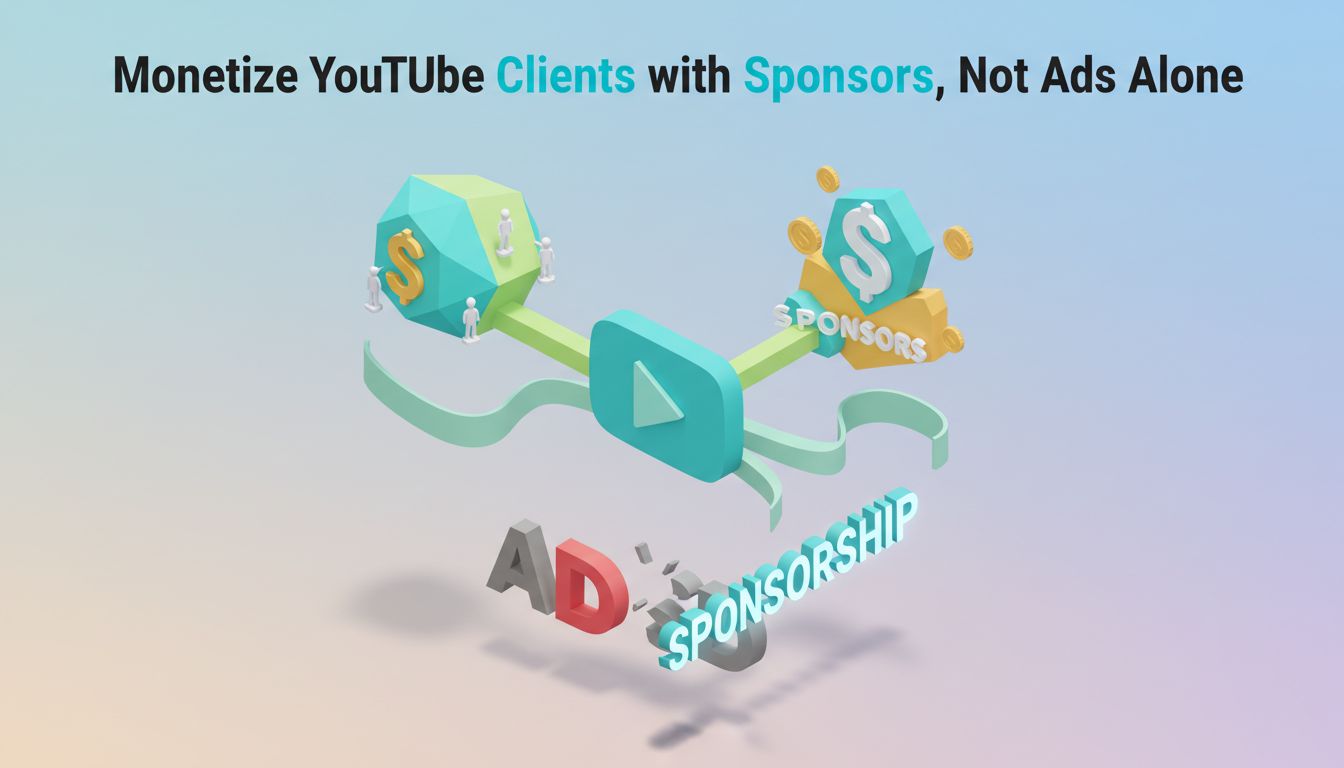
Monetize YouTube Clients with Sponsors, Not Ads Alone
If your plan to monetize client YouTube channels is "grow views, turn on ads, hope for the best," you are leaving serious money on the table.
Ad revenue is fine. It is just a terrible main business model for agencies and small media teams.
If you want to monetize client YouTube channels with sponsors in a way that helps your clients and grows your own fees, you need to treat sponsorships as a product, not a happy accident.
That is what this is about.
You are not just selling video production. You are selling access to a specific audience, packaged in a way brands can actually buy.
Sponsor revenue is how you turn a YouTube service into a YouTube business.
Why sponsors should be a core part of your YouTube offer
The ceiling of ad-only revenue for client channels
Let us be blunt.
Most branded channels will never hit the kind of scale where ad revenue feels meaningful.
A typical scenario:
- You produce a weekly video for a B2B client.
- The channel averages 5k to 20k views per video.
- Watch time is solid, retention is decent, comments are real.
That audience is extremely valuable to the right sponsor.
To YouTube ads, it is pocket change.
Here is a rough comparison.
| Channel type | Monthly views | Typical ad revenue range | Realistic sponsor value |
|---|---|---|---|
| Niche B2B channel, 4 vids / month | 80k | 80 to 240 dollars | 2k to 10k dollars |
| Mid-sized hobby channel | 300k | 300 to 900 dollars | 3k to 20k dollars |
| Established brand channel, 1M views | 1,000,000 | 1k to 3k dollars | 10k to 50k dollars |
YouTube ads are a commodity. Sponsorships are a relationship.
Ad-only thinking keeps you stuck in "let us make more videos and hope views grow."
Sponsor thinking asks "who would pay to be in front of this exact audience, right now?"
How sponsor income changes your agency’s positioning and fees
Once you introduce sponsors, your positioning shifts.
You are no longer just "the video team" or "the YouTube agency."
You become the team that:
- Grows a channel.
- Brings in revenue.
- Offsets or even covers your own fees.
That last point is the unlock.
Imagine you charge a client 5k dollars per month for YouTube strategy and production.
If you also structure and manage a sponsor pipeline that:
- Brings in 3k to 15k dollars per month in sponsor deals.
- Includes reporting, negotiation, and creative integrations.
You are not a cost center. You are an income engine.
That justifies:
- Higher retainers.
- Longer contracts.
- A more strategic seat at the table.
You are suddenly talking to CMOs and revenue leaders, not only content managers.
[!TIP] When you can point at a sponsor contract and say, "this one deal pays for our entire retainer," client conversations change overnight.
What brands actually want from sponsored YouTube content
The metrics that matter in sponsor conversations
Brands do not care about YouTube monetization settings.
They care about outcomes that map to their funnel.
Different sponsors want different things, but a useful way to frame it is:
| Sponsor focus | They care about | The metrics you highlight |
|---|---|---|
| Awareness | Reach, alignment, brand safety | Views, unique viewers, watch time, brand fit, sentiment |
| Consideration | Education, trust, brand recall | Average view duration, click-through rate (CTR), comments, branded search lift |
| Direct response | Leads, trials, purchases | Clicks, conversions, cost per lead (CPL), revenue per placement |
Most agencies pitch sponsors with "our videos get 10k views."
Useful, but shallow.
Sponsors want to know things like:
- Who are these people, really.
- What they do, buy, struggle with.
- How they respond when you recommend something.
If you can say:
"This channel reaches 30k monthly viewers. Mostly mid-level IT decision makers in North America. Our how-to episodes drive a 3.4 percent click-through rate on links in the description and viewers watch an average of 7 minutes per episode."
You are no longer selling impressions. You are selling context and behavior.
Packaging influence, storytelling, and data into one offer
Sponsors are not just buying a logo in a lower third.
They are buying three things combined:
Influence Your client's trust with their audience. The ability to say "we use this tool" and have people care.
Storytelling The way your team can fold a sponsor into a narrative so it feels native. Not a clumsy interruption.
Data The ability to measure what happened and refine future placements.
Your job is to package those three into a clear sponsor offer.
Think of something like:
"We produce a weekly show for X audience. Sponsors get a story-first integration in the episode, a placement in the title and thumbnail when relevant, links and CTAs in the description and pinned comment, and post-campaign performance reporting."
Notice what is missing.
There is no "30 seconds mid-roll, take it or leave it."
You are not selling seconds. You are selling a moment of attention, inside a trusted environment, with proof that it worked.
How to design a simple, repeatable sponsor pipeline
Clarifying your niche, audience, and value proposition
Sponsorships are easier when your channels are not generic.
Sponsors want "this show reaches the exact people we care about."
So step one is clarity:
- What verticals do your client channels serve.
- Who the actual viewer is.
- Why they watch.
If you run production for several clients in, say, SaaS, DevTools, or e-commerce, you already have an ecosystem.
Your value proposition to sponsors can sound like:
"We run YouTube programming for 5 brands that collectively reach 150k monthly viewers in the B2B SaaS space. We help tools that serve this audience integrate across shows."
Now your pitch is not just about one channel. It is about access to a niche network.
Building a lightweight sponsor CRM and outreach rhythm
You do not need a massive sales org.
You do need a system, even if it is simple.
At minimum, track:
- Potential sponsors and their contact info.
- Which client channels they could fit.
- Status: cold, interested, negotiating, active, past sponsor.
- Notes, last touch, next action.
You can do this in a spreadsheet, Notion, or a dedicated tool.
This is where something like SponsorRadar can be useful. A focused sponsor CRM keeps you from losing deals in inbox chaos and helps you see patterns across clients.
The magic is not the software though. It is the rhythm.
For example:
- 1 day per week is outreach and follow up.
- 10 to 20 high quality contacts per week, not 200 spam emails.
- A habit of logging every touchpoint and next step.
You do not need thousands of sponsors. You need 10 to 30 that actually care about your segments.
Creating templates for pitches, media kits, and rate cards
You want to standardize just enough so you can move quickly, but keep room for tailoring.
Useful templates to create once:
A sponsor one-pager for each client channel Who it reaches, what formats exist, what makes it unique.
A combined network deck If you manage multiple channels in similar niches, package them together.
A rate card framework Not rigid public pricing, more like internal guidance for what you charge.
Each template can be customized for a specific sponsor.
An email pitch might look like:
"We run YouTube for [Client], which reaches [Audience] through [Format]. We are lining up sponsors for Q2 on episodes about [Theme]. Given your focus on [Problem they solve], we think there is a clean story fit. Our integrations typically include [Elements]. Happy to share examples and performance data."
Short. Specific. Contextual.
[!NOTE] Most sponsors are not offended by rate cards. They are offended by confusion. Make it easy to understand what they can buy, at what order of magnitude, and where there is negotiation room.
Turning episodes into sponsor-ready inventory
Structuring shows and formats brands can plug into
You cannot sell inventory you have not designed.
If your client content is a random mix of topics, lengths, and styles, sponsors will struggle to understand what they are buying.
Think in formats, not just episodes.
Examples:
- A weekly "news and analysis" show.
- A monthly "deep dive" tutorial.
- A recurring "customer stories" series.
- A seasonal "challenge" or "build" series.
Each format is potential sponsor inventory.
You can define, for each format:
- Where a sponsor can be integrated.
- How heavy or light the integration feels.
- What kind of brands tend to fit.
Imagine you produce a weekly show for a cybersecurity company.
You might standardize:
- 5 to 8 minute episodes.
- Cold open hook.
- Sponsor mention early, tied to the problem in the episode.
- Main content.
- Optional end-screen reminder.
Now you can confidently tell a sponsor "you will get 15 to 30 seconds of contextually relevant integration at the start of each episode, for this many episodes in a month."
Pricing placements: pre-rolls, mid-rolls, series, and bundles
Pricing is art plus math.
The math looks like:
- Average views per episode.
- Engagement rate.
- Audience value. (B2B and high-ticket audiences can justify higher CPMs.)
- Sponsor category competitiveness.
The art is how you package those into offers that are easy to say yes to.
Typical pieces you can sell:
| Inventory type | What it is | When to use it |
|---|---|---|
| Pre-roll integration | Early segment, contextual, host-read | High-visibility, general sponsors |
| Mid-roll integration | In-content segment, often deeper explanation | Tools and products that need a bit more setup |
| Sponsored episode | Whole episode framed around a topic they care about | Strong story fit, but still audience-first |
| Sponsored series | Multi-episode arc with consistent sponsor | Larger deals, strategic partners |
| Network bundle | Placement across multiple client channels | When you manage a vertical, higher ticket deals |
A simple approach is to start from a CPM floor, then add premiums for:
- Better placement.
- Deeper integration.
- Multi-episode commitments.
- Multi-channel bundles.
For example, you might target an effective CPM of 60 to 200 dollars for a tightly defined B2B audience. A 10k view episode with a premium integration might be 600 to 2k dollars for a single placement, then you offer discounts for multi-episode buys.
The key is consistency. Decide your ballpark. Track outcomes. Adjust.
Do not price every deal from scratch in a panic.
Scaling from one-off deals to a stable sponsor roster
Keeping sponsors renewing without killing creativity
The biggest sponsor money is in renewals, not first deals.
Getting a sponsor once proves the concept. Getting them three times proves you have a product.
To keep renewals healthy without turning the channel into an ad fest:
Protect the viewer first. Every integration should add value, not derail the episode.
Set clear guardrails with sponsors. What you will do. What you will not do. What "on brand" means for your client.
Refresh creative within the format. Rotate how you talk about the product. Use different stories, use cases, or CTAs over time.
For example, month one you focus on "problem and solution." Month two you highlight a specific feature through a mini story. Month three you showcase a customer example tied to the sponsor.
Same sponsor, evolving creative, still serving the audience.
[!IMPORTANT] If your viewers start skipping the sponsor segments, you do not have a sponsor problem. You have a creative and alignment problem. Fix the story, not just the contract.
Reporting, case studies, and upsells across your client base
Sponsors stay when they can show internally that your placements worked.
So your reporting needs to be more than "here is a screenshot from YouTube Studio."
Useful sponsor reports usually include:
- Episode performance vs channel averages.
- Click and conversion data from trackable links or promo codes.
- Qualitative signals, like comments mentioning the sponsor.
- Any downstream impact your client can see, such as demo requests or sign ups.
Turn strong results into case studies you can reuse.
"On [Client] channel, [Sponsor] saw X percent higher click-through than their other paid channels. Over Y episodes, they generated Z leads at an effective CPL of N dollars."
That story can unlock:
- Renewals with that sponsor.
- Bigger packages across multiple client channels.
- New sponsors in the same category.
This is where a tool like SponsorRadar can help you operationalize.
By centralizing:
- Which sponsor ran where.
- What they paid.
- What results they got.
You can spot patterns like:
- "DevTools sponsors perform best on channels A, B, and C when we do mid-roll tutorials."
- "Fintech sponsors renew more often when we include a short testimonial in the integration."
That insight is what lets you move from "we got a sponsor" to "we run a sponsor program across our client base."
Where to take this next
If you only remember one thing from all this, make it this:
You are not just creating YouTube content. You are building media properties your clients own. Sponsors are how you turn those properties into revenue, not just brand spend.
The path looks like:
- Clarify who your channels really reach.
- Turn episodes into consistent, sponsorable formats.
- Build a lightweight sponsor CRM and outreach rhythm.
- Standardize your offers and price with intention.
- Report results, collect wins, and roll them across your client roster.
You do not need a hundred sponsors and a sales floor buzzing with headsets.
You need a system that fits your size, respects your creative standards, and proves your work drives revenue, not just views.
If you are running multiple branded channels already, the seeds are likely there. The next step is to treat sponsor revenue as a core product of your agency, not an occasional bonus.
Start with one channel, one offer, one sponsor. Then turn what works into your repeatable playbook.