
About 92% of brands either already use AI in influencer marketing or are open to using it, while 59% say AI is already integrated into at least one influencer workflow, according to 2026 influencer marketing research from Presence. That adoption figure changes the buying question. The issue isn't whether an AI powered influencer marketing platform sounds new. It's whether its data helps teams choose better creators, negotiate more intelligently, and connect sponsorship activity to measurable commercial outcomes.
The market is developing into a repeatable software category rather than a collection of experiments. One 2026 market estimate values the influencer marketing platform market at USD 1.15 billion in 2026 and projects it to reach USD 2.03 billion by 2031, representing a 12.0% CAGR over that period. That expansion creates room for discovery engines, sponsorship databases, campaign-management systems, analytics products, and creator-first tools to coexist.
The important distinction is that AI is gaining traction mainly as an operating layer for human partnerships. Only about 9% of marketers want AI or virtual influencers to replace human creators, and just 2% plan to create an AI avatar for brand representation, as reported in the same Presence study. The practical opportunity is therefore less about synthetic personalities and more about better evidence behind real creator deals.
Table of Contents
- What an AI Powered Influencer Marketing Platform Actually Does in 2026
- How the Core Engine Works From Data to Match
- Common AI Features That Move the Needle
- How to Evaluate Any AI Influencer Marketing Platform
- Real Use Cases for Creators and Brand Teams
- Implementation Best Practices and a 90 Day Rollout
- The Honest Truth About AI in Influencer Marketing
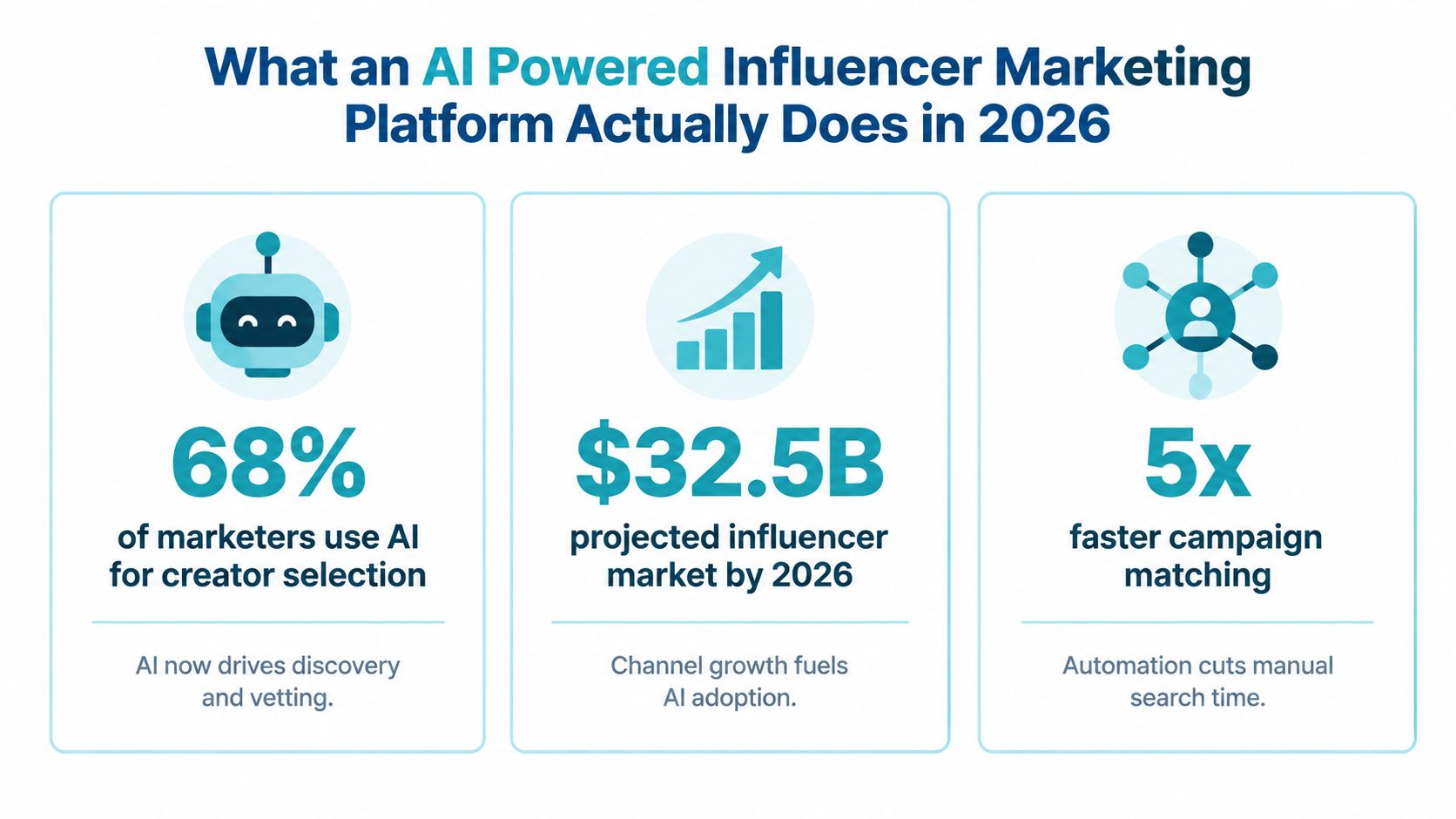
What an AI Powered Influencer Marketing Platform Actually Does in 2026
An AI powered influencer marketing platform combines creator data, audience intelligence, brand information, and campaign results in one decision system. It helps a brand or agency search for relevant creators, assess audience quality, estimate likely performance, automate outreach, and compare outcomes after publication.
That definition matters because many products use “AI” to describe very different capabilities. A simple CRM stores contacts. An analytics dashboard displays results. A content assistant drafts messages. An AI platform should connect these activities so that discovery informs outreach, outreach informs campaign management, and campaign performance improves future recommendations.
Where the platform sits
The software usually occupies the space between several martech systems:
- Social listening tools identify conversations, topics, and emerging communities.
- Influencer relationship management systems organize creators, contracts, deliverables, and communication.
- Commerce and attribution tools connect creator activity with sales, leads, or site behavior.
- Creative systems help teams brief, review, tag, and repurpose sponsored content.
- AI matching layers rank potential partners against campaign requirements and historical evidence.
Brands use these platforms to reduce manual research and improve partner selection. Agencies use them to manage multiple clients, creator categories, and reporting requirements. Creators increasingly use related systems to identify active sponsors, understand category demand, and prepare stronger commercial pitches. A practical introduction to the creator-side workflow is quso.ai's guide to AI influencer marketing for creators.
The category isn't defined by the presence of a chatbot. It earns the label when algorithms process structured signals and produce an actionable recommendation, such as which creators fit a brief, which sponsors have demonstrated interest in a niche, or which audience segments overlap with an existing customer base.
For YouTube teams, the distinction between generic content discovery and sponsorship intelligence is especially important. A content discovery platform may help surface relevant videos or channels, while a sponsorship-focused system needs evidence of commercial relationships, deal activity, and audience fit.
Practical rule: Treat AI as a method for turning messy creator data into decisions. Don't treat it as a decorative label on a familiar dashboard.
The strongest products preserve human judgment. They make a large candidate set manageable, expose the signals behind a recommendation, and leave negotiation, creative interpretation, and relationship building with the people responsible for the partnership.
How the Core Engine Works From Data to Match
A credible platform begins with data plumbing, not a polished recommendation screen. Its value depends on whether the system can collect current information, reconcile conflicting records, and show users why a creator appears in a shortlist.
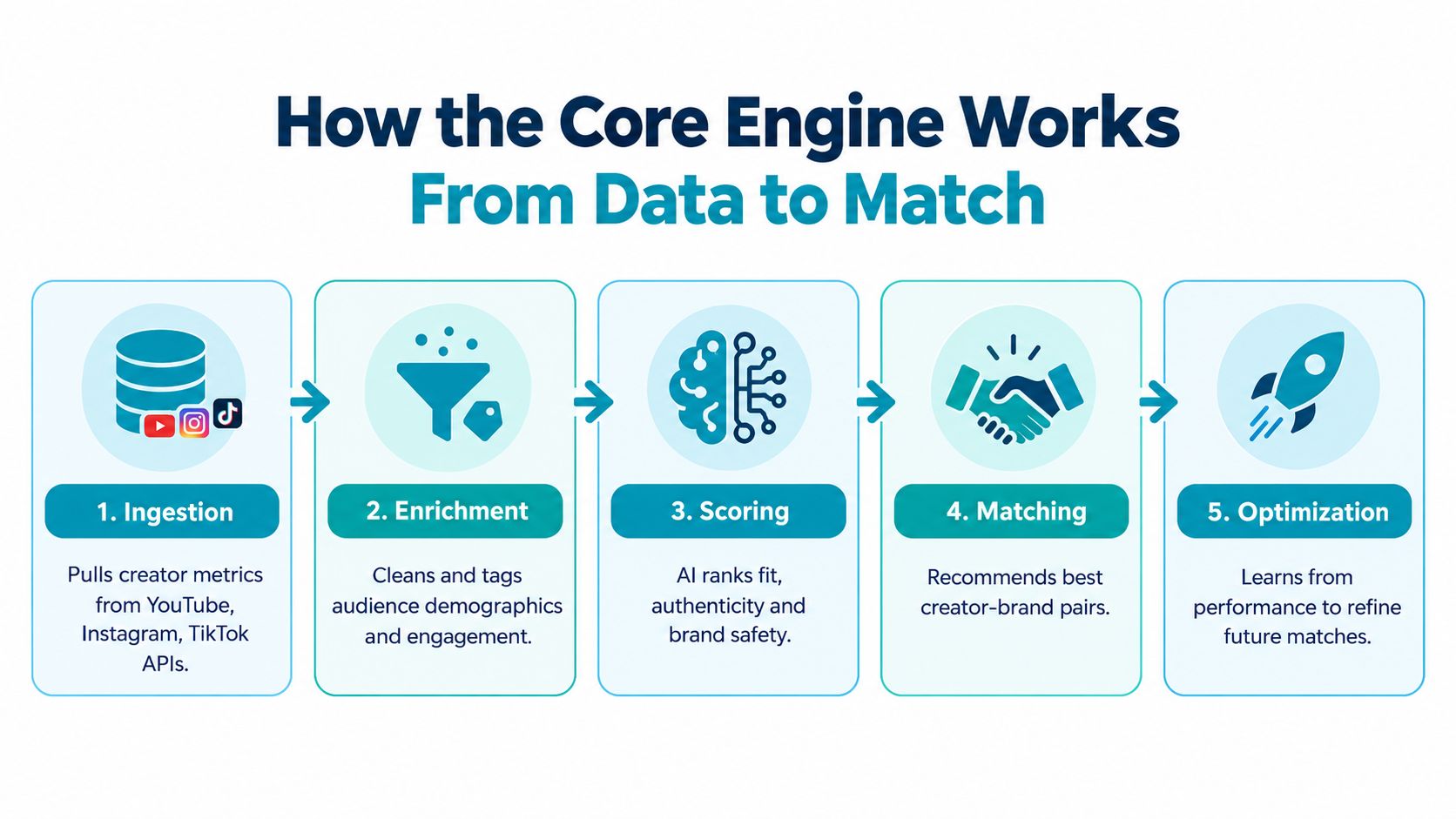
The five-stage pipeline
1. Ingestion brings in creator metrics, audience information, content metadata, brand records, and campaign history. APIs can provide structured information from major social platforms, while first-party systems add customer, commerce, and CRM context. CreatorDB's API, for example, exposes 45 endpoints across 30M+ creator profiles, with sponsorship history, audience demographics, content analysis, and brand relationships returned in JSON over HTTPS, according to the technical description in this 2026 review of AI influencer tools.
2. Enrichment and normalization make those records comparable. The system must deduplicate profiles, resolve identity across networks, identify suspicious activity, and account for different definitions of reach, views, engagement, and audience composition. A follower total has limited value if the platform can't distinguish active viewers from inactive or inauthentic accounts.
3. Feature engineering converts raw records into signals a model can score. These may include content themes, audience geography, engagement quality, brand-safety indicators, prior sponsor categories, posting consistency, and observed relationships between brands and creators. Sponsorship history adds a particularly useful commercial signal because it shows what a creator has promoted, not merely what their profile appears to represent.
4. Matching and prediction rank creators against a campaign brief. A model might compare category relevance, audience overlap, creative format, historical engagement, and estimated pricing. It can also forecast proxy outcomes such as views or engagement. Teams should be cautious with conversion predictions because conversion depends on offer, landing page, creative execution, attribution, and purchase intent, not only creator characteristics.
5. Delivery and feedback push recommendations into outreach, campaign management, reporting, and renewal workflows. Post-campaign results then become training and evaluation data. Without this feedback loop, the product remains a search tool with an AI-flavored interface.
The refresh cadence affects every stage. Fast-changing metrics become stale quickly, while sponsorship relationships may remain useful for longer. A buyer should ask when each data field was last updated, whether the system records historical snapshots, and whether users can inspect the original evidence.
CreatorDB's bidirectional sponsorship structure illustrates why graph design matters. On the brand side, the system can identify creators a brand has sponsored, including sponsored-content URLs, engagement rates, and last-sponsored dates. On the creator side, it can surface recent sponsored posts and the brands behind them. That allows a platform to match from either direction and benchmark observed sponsor behavior instead of inferring commercial fit from audience size alone.
For a deeper look at the underlying data category, compare this workflow with a dedicated influencer marketing database.
The pipeline becomes useful only when the platform exposes enough provenance for a human to challenge it. If a recommendation can't be traced to current creator records, audience evidence, and campaign outcomes, its apparent intelligence may be impossible to audit.
Common AI Features That Move the Needle
Feature lists make platforms look interchangeable. Campaign results don't come from feature count. They come from whether a capability improves a decision that affects creator fit, deal speed, delivery quality, or attributable revenue.
| Feature Category | Vendor Promise | Realistic Outcome | Best Fit For |
|---|---|---|---|
| Discovery and matching | Find the perfect creator through semantic search and lookalike recommendations | Produces a faster shortlist, but results depend on coverage, freshness, and identity resolution | Brands and agencies with broad candidate pools |
| Performance forecasting | Predict views, engagement, CPM, or conversions before spend | Proxy metrics can be estimated, while conversion forecasts require strong first-party and campaign data | Teams with consistent historical reporting |
| Content intelligence | Parse briefs, tag creative, and draft outreach | Reduces repetitive work, but generated language still needs human review for tone and accuracy | Brand teams handling high outreach volume |
| Workflow automation | Automate follow-ups, contracts, approvals, and payments | Shortens administration time when integrations are reliable | Agencies and mature creator programs |
Discovery is valuable, but coverage is the constraint
Creator discovery remains the leading AI use case, at about 36.7% of brands using AI, according to Impact's coverage of performance-focused influencer marketing. The number supports a straightforward conclusion. Teams are asking AI to reduce search effort before they ask it to replace human creativity.
Coverage varies sharply between tools. Independent 2026 evaluations cite databases ranging from 12M+ creators to 250M+ creators, while enterprise products such as CreatorIQ are positioned at $3,000+/month and discovery-focused tools such as Modash are described as covering 250M+ creators, according to Janney's platform evaluation. Those figures aren't interchangeable quality scores. A large graph improves recall, but stale profiles or weak audience verification can still produce poor candidates.
Content intelligence is useful for parsing a brief into searchable concepts and identifying recurring themes in a creator's work. It shouldn't decide whether a creator's humor, values, or storytelling style fits a brand. Teams exploring adjacent creative applications, including fashion film AI solutions, should apply the same discipline. Generative capability can accelerate production, but it doesn't replace a validated performance signal.
Workflow automation often produces the clearest operational benefit. Follow-up sequences, approval routing, contract status, and payment reconciliation are repetitive tasks with visible failure points. Yet automation can also magnify mistakes. An incorrect rate, a poorly timed reminder, or an irrelevant pitch damages trust faster when a system sends it at scale.
For creators, discovery and contact retrieval can shorten the path from research to a relevant pitch. For brand teams, forecasting, audience comparison, and portfolio reporting matter more. The shared requirement is evidence. A platform should show whether its recommendation led to a better deal or merely generated a longer list.
How to Evaluate Any AI Influencer Marketing Platform
Start with the output you need, then work backward to the data. A vendor that promises “AI-powered optimization” should be able to explain which metric it optimizes, what inputs it uses, and how your team can reproduce the calculation outside the platform.
Four questions that expose weak products
Metrics. Ask the vendor to define every performance measure in plain mathematics. Cost per view is spend divided by attributed views. Cost per engagement is spend divided by measured engagements. Earned media value per dollar requires a stated valuation method, not a silent benchmark. Attribution also needs a defined window, source of truth, and treatment of assisted conversions. If two campaigns use different rules, their results aren't comparable.
Data quality. Request the refresh date for creator metrics, audience records, sponsorship history, and contact information. Ask how the system handles duplicate profiles, cross-platform identity, suspicious engagement, and missing fields. A strong demonstration includes raw inputs that your team can spot-check rather than only a composite score.
Integrations. Test the path from creator selection to outcome measurement. Relevant connections may include YouTube Analytics, Shopify, GA4, CRM records, affiliate systems, and creator-side tools. Verify permissions, webhook behavior, rate caps, export formats, and failure handling before procurement. A platform that can't reliably receive campaign outcomes can't improve its recommendations.
Pricing. Model the complete cost, not just the subscription. Include seats, creator-search limits, data exports, contact access, marketplace take rates, onboarding, support, and overage charges. A lower headline price can become expensive if your workflow depends on paid records or additional users.
A 60-minute bake-off should use the same campaign brief, the same creator category, and the same evaluation questions for every vendor. Score the evidence, not the presentation.
| Criterion | What to Ask | Score 1-5 | Weight |
|---|---|---|---|
| Metric transparency | Can the team reproduce CPV, CPE, attribution, and forecast calculations? | 1-5 | High |
| Data freshness | Are update times, historical snapshots, and source fields visible? | 1-5 | High |
| Creator coverage | Does the database contain relevant creators in your markets and formats? | 1-5 | High |
| Audience quality | Can the system expose authenticity and demographic evidence? | 1-5 | High |
| Integrations | Does it connect to analytics, commerce, CRM, and creator workflows? | 1-5 | Medium |
| Workflow depth | Can it manage outreach, approvals, contracts, and reporting? | 1-5 | Medium |
| Total cost | Is pricing predictable at your expected volume? | 1-5 | Medium |
Use a weighted score rather than choosing the vendor with the most features. A platform that improves data confidence but lacks payment automation may still be the right discovery layer. A full-service system may be justified when campaign administration, reporting, and commerce attribution are the bottlenecks. For a broader comparison of analytics products and trade-offs, see this analytics tools comparison.
Real Use Cases for Creators and Brand Teams
A brand and a creator can use the same data system while optimizing for different outcomes. The brand wants incremental reach, qualified attention, and efficient acquisition. The creator wants suitable sponsors, reliable payment, audience compatibility, and a relationship that can continue without exhausting the channel.
Consider a DTC skincare launch with a large applicant pool. An AI scoring layer can filter applicants by audience attributes, content relevance, engagement quality, and prior category activity before a human team reviews the shortlist. The value isn't the score itself. The value is giving reviewers a consistent reason to reject weak fits and prioritize candidates who warrant a conversation.
A gaming publisher has a different problem. It may need to compare creator categories, formats, historical sponsor activity, and expected pricing before committing campaign budget. The useful output is a transparent range of scenarios, not a confident-looking prediction detached from the publisher's offer, creative, and conversion path.
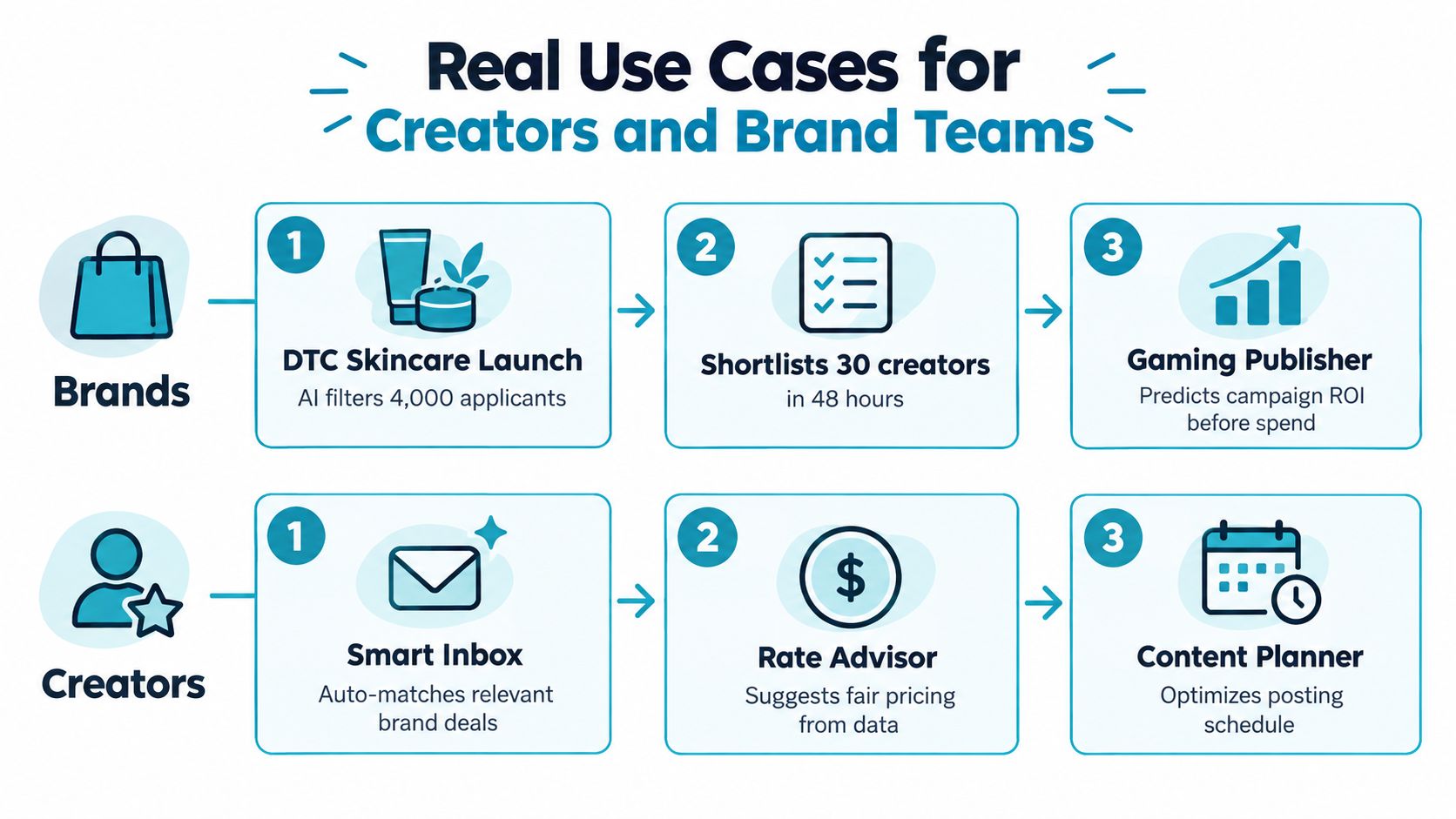
The creator-side workflow is more commercial than analytical
A mid-tier YouTube creator researching sponsorships needs answers that general brand platforms may not prioritize:
- Which brands are already sponsoring channels in the same niche?
- Which companies appear repeatedly across comparable creators?
- Who handles partnerships at those brands?
- What content and deal patterns can inform a credible pitch?
- How should the creator organize follow-ups and renewals?
SponsorRadar tracks sponsorship history across YouTube channels and brands, and its creator workflow includes sponsor discovery, decision-maker contacts, media-kit creation, and outreach organization. That makes it a creator-first data layer rather than a general campaign command center.
The distinction becomes clear in a hypothetical YouTube workflow. A creator can study similar channels, identify recurring sponsors, compare recently sponsored videos, and use audience and engagement information to shape a pitch. A brand-side platform may identify the creator as a demographic match, but it may not answer the creator's immediate question, which is whether a sponsor is actively buying in that niche and how to approach the relationship.
Brands benefit from graph breadth and portfolio analytics. Creators benefit from commercial context. Agencies need both, but they should avoid assuming that one interface can serve every user equally well.
The useful match is not simply creator to brand. It's evidence to decision, then decision to measurable deal outcome.
Implementation Best Practices and a 90 Day Rollout
Implementation should begin with measurement discipline, not mass automation. If a team can't explain its current creator-selection process and campaign economics, an AI system will make the workflow faster without proving that it made the decisions better.
Days 1 to 15, establish the baseline
Document the existing process from discovery through payment. Connect the relevant pixels, analytics accounts, commerce systems, and CRM fields. Audit creator records for duplicates, stale contacts, missing sponsorship history, and inconsistent metric definitions.
Use a control campaign or a comparable historical campaign where possible. Record how the team currently selects creators, how long research takes, which signals influence approval, and how the organization defines success. The baseline doesn't need to be perfect. It needs to be explicit.
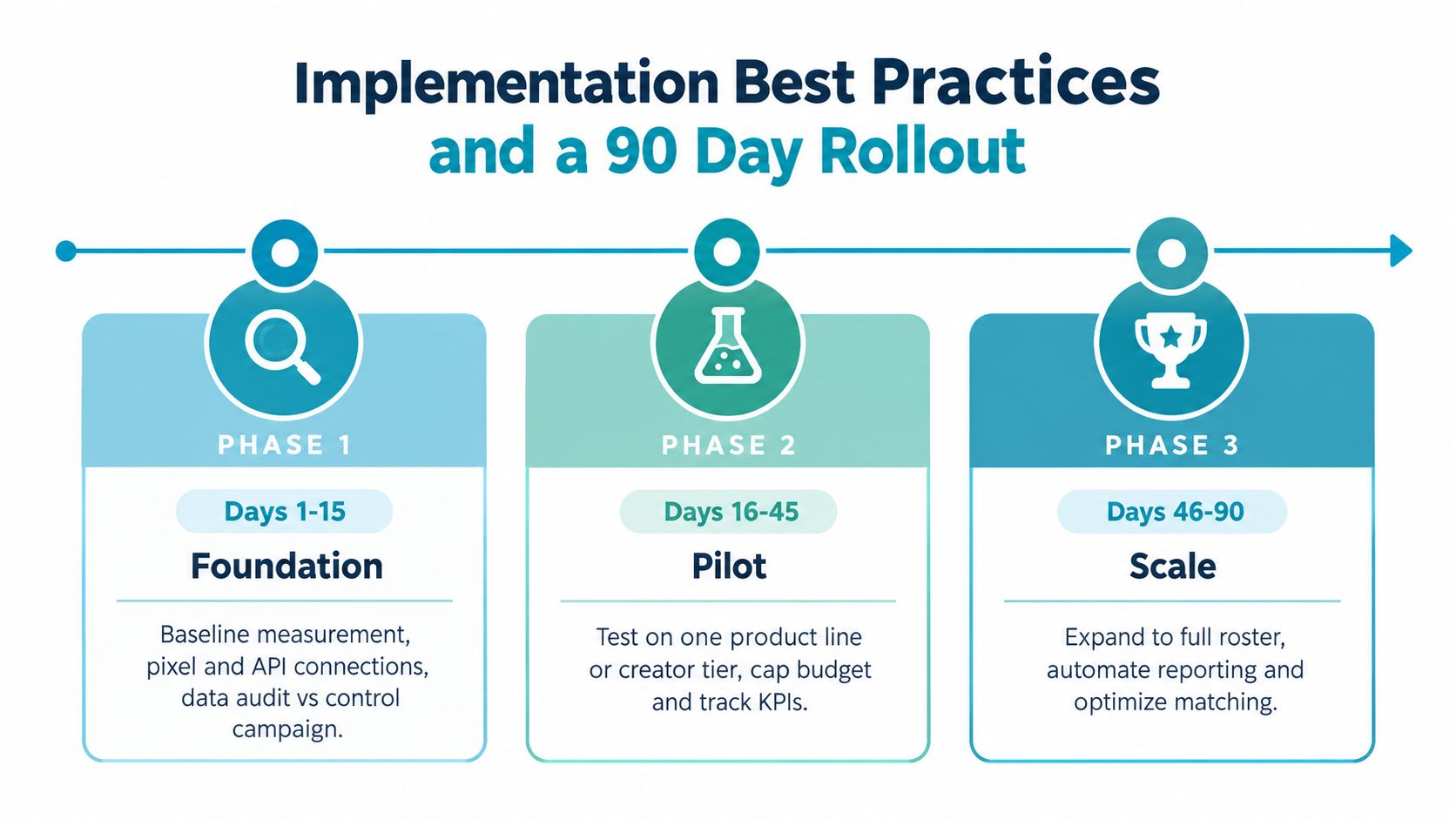
Days 16 to 45, run a controlled pilot
Choose one product line, market, or creator tier. Don't automate every outreach motion at once. Compare AI-assisted selection with the existing manual process using the same approval standards and campaign objective.
Set kill criteria before launch. These may include unacceptable CPA, weak click quality, poor creator overlap, missing deliverables, or a recommendation error rate that forces excessive manual correction. The pilot should test both efficiency and decision quality. Faster shortlisting isn't a win if the team spends that time repairing poor matches.
Days 46 to 90, expand carefully
Add product lines or creator groups only after the pilot produces interpretable evidence. Feed campaign learnings into future briefs, document exceptions, and standardize reporting fields. Review whether the platform's forecasts align with observed results across different niches and formats.
A defensible ROI calculation separates value from cost:
ROI = attributable contribution generated by influencer activity minus platform, creator, production, and management costs, divided by total campaign cost.
Use the same attribution rules across the review period. Keep incremental tests separate from last-click reporting, and don't let reach substitute for commercial evidence. A quarterly business review should be able to show what changed, which data supported the change, and whether the result justified continued investment.
The Honest Truth About AI in Influencer Marketing
More AI features do not guarantee better sponsorship outcomes. The strongest applications handle work that depends on searching large datasets, filtering repeatable signals, comparing records, and identifying patterns that manual review may miss. That makes data quality and measurable ROI more useful evaluation criteria than feature count.
The limits are equally practical. Models can rank creators, yet they may miss negotiation context, a brand's creative intent, or the relationship needed to build trust with a creator. They can detect engagement patterns, but an engagement score does not prove that a specific audience will act.
Industry adoption points to assistance rather than replacement. Brands are applying AI to workflow stages, while synthetic creators remain a minority preference, according to the 2026 Presence findings. Teams should assess whether a platform makes creator selection auditable and performance intelligence useful, rather than count generated copy or virtual-influencer features.
Common failure patterns include:
- Follower-count bias: Scale receives priority while engagement quality and audience relevance receive less attention.
- Unvalidated scoring: A composite score appears precise, but the vendor cannot show which outcomes it predicts.
- Stale sponsorship data: Old relationships remain visible after a creator's commercial activity or audience behavior changes.
- Proxy confusion: Views or engagement are treated as conversion evidence without a defensible attribution link.
- Automation without judgment: Generic outreach increases volume while producing fewer credible conversations.
SponsorRadar covers a narrower layer of the AI influencer stack. It surfaces YouTube sponsorship activity, similar-channel relationships, sponsor overlap, contacts, and creator outreach workflow. That focus suits commercial discovery when a team needs evidence about sponsorship history and partnership fit, rather than a full enterprise campaign system.
A practical seven-day test has four parts:
- Audit current tools: Record each source of creator, audience, sponsor, and campaign data.
- Choose one KPI: Define the result that determines whether the test worked.
- Run a parallel comparison: Apply human review and AI-assisted review to the same brief.
- Review at 30 days: Compare shortlist quality, deal progress, data corrections, and attributable outcomes.
SponsorRadar helps creators and agencies research YouTube sponsorship history, identify brands active in comparable channels, find partnership contacts, and organize outreach with creator-focused portfolio tools. Visit SponsorRadar to evaluate sponsorship opportunities with evidence instead of relying on follower counts or generic AI recommendations.