
The most popular advice about YouTube trending videos is also the least useful: keep refreshing the Trending tab until you find the next viral idea. That approach turns a public market signal into entertainment. A better approach treats trending content as live commercial intelligence, showing which formats are holding attention, which audiences are moving across markets, and which categories are attracting active sponsorships.
Virality still matters, but it isn't a business model by itself. A spike can produce attention without loyalty, and a hit built around the wrong audience can make your next upload harder to position. The commercial opportunity sits in the pattern behind the spike. Identify that pattern, connect it to brands already buying attention, then adapt it into a repeatable format your channel can deliver.
Table of Contents
- Why Trending Videos Are a Goldmine for Brand Deals
- Decoding Trend Durability and Cross-Market Signals
- Spotting Sponsor Signals in High-Velocity Content
- Translating Trend Data Into Sponsor-Ready Formats
- Executing Data-Backed Pitches With SponsorRadar
- Tracking Pipeline Metrics and Sponsorship ROI
Why Trending Videos Are a Goldmine for Brand Deals
Creators often use the Trending tab as a vanity leaderboard. They chase the highest view count, copy the subject, and wait for the algorithm to do the rest. The commercial question is more useful: what kind of audience attention are brands currently willing to fund?
A trending video is a public sample of active demand. It shows the topic, format, pacing, creator profile, language, and audience context attracting attention at the same time. That evidence does not guarantee a sponsor will pay for an imitation. It gives you a stronger starting point than personal preference or an outdated content calendar.
YouTube trending videos also provide enough material for market research at global scale. A recent archival dataset covered 78,391,390 trending video entries, 446,971 snapshots, and 104 countries between July 1, 2022 and June 30, 2025. It represented 726,627 unique videos with 98% snapshot coverage (archival research on YouTube Trending). The implication for creators is practical: Trending is a continuing record of market behavior, not a ranking of winners.
Read the chart as a buyer would
A sponsor evaluates more than popularity. The buyer needs an audience that fits the offer, a format that can carry an integration, and a creator who can reproduce the result without weakening viewer trust.
Review YouTube trending videos with five questions:
- Format: Is it a long-form review, reaction, challenge, tutorial, trailer, gaming clip, interview, or Short?
- Audience promise: What does the viewer expect to receive in the opening moments?
- Commercial fit: Can a product enter the story naturally, or would the placement interrupt the experience?
- Repeatability: Can the format support several episodes without becoming a copy?
- Market relevance: Does the hook depend on a local event, or can its core idea travel?
Product-led channels can apply the same test. If you are researching themes for a podcast, video series, or commerce project, the best POD niches for 2025 can provide category prompts. Treat that resource as a starting point, then check current YouTube behavior before building an offer around it.
Turn scrolling into a sponsor map
Create a research sheet with columns for video, category, format, geography, visible sponsor, integration position, and likely buyer category. Review enough entries to identify clusters. You may see brands repeatedly appearing beside a gaming format, travel problem, beauty routine, or regional-language entertainment pattern.
Those clusters support better outreach. A gaming accessory company has a clearer reason to consider a creator who can reproduce a rising gaming format. A beauty brand can assess whether the audience promise creates a natural product demonstration. The trend supplies the lead, while the creator's repeatable execution supplies the deal logic.
The useful question is, “Which audience is active, which content structure is holding it, and which companies already want access to it?”
Commercial rule: A trend becomes useful when it improves a programming decision and produces a more specific sponsor pitch.
Decoding Trend Durability and Cross-Market Signals
A one-day spike can attract attention while remaining a weak basis for a paid campaign. Sponsors need time to approve creative, negotiate terms, produce assets, publish the integration, and assess results. The practical task is separating temporary noise from a format with enough shelf life to support a deal.
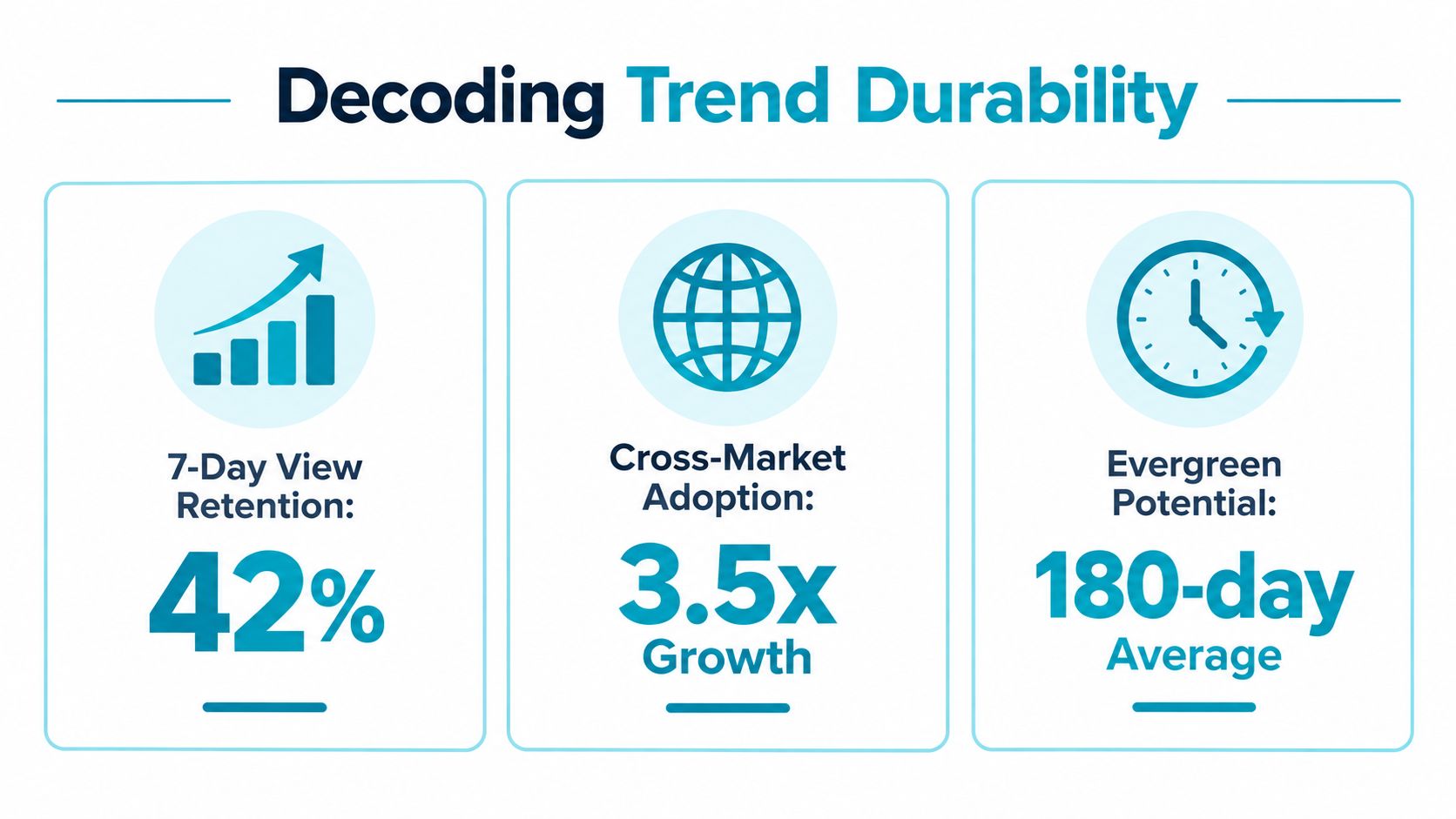
The archival dataset cited earlier provides a useful reference. A video's first appearance on Trending came with a median of 437,571 views, and the median Trending stay was 217.14 hours, about nine days (YouTube Trending archival dataset). These figures do not guarantee results for any channel. They do show why persistence matters: creators may have a window to study the format, identify active sponsor categories, and build a relevant response before attention fades.
Use three filters before committing
Persistence comes first. Compare the same category across multiple ranking snapshots rather than reacting to one title. A recurring format, creator type, or audience problem gives a stronger programming signal than an isolated spike.
Portability is the second filter. Cross-market appearances indicate whether a concept survives translation, dubbing, visual explanation, or regional adaptation. A format that travels can give a sponsor a broader campaign angle, provided the audience promise remains clear in each market.
Commercial compatibility completes the test. A portable meme may be difficult to sponsor because its joke expires quickly. A repeatable challenge, comparison, tutorial, or product-use narrative may attract fewer instant views but offer cleaner integration and measurement.
Separate global scale from local strength
Local trends deserve careful review. Regional relevance can create stronger audience trust and a clearer sponsor fit than a global entertainment release. Market rank and commercial reach are different signals. Some videos appear across many countries, while top rankings vary sharply by market (worldwide YouTube trending tracker dataset). A country's leading video is therefore not automatically the most portable opportunity.
Ask four questions:
- Does the hook depend on language, location, or cultural context?
- Can another creator reproduce the structure without copying the original?
- Does the audience need explanation, demonstration, or participation?
- Can a sponsor appear without weakening the reason viewers clicked?
Record the answers in a worksheet, then compare them over time. SponsorRadar's trend forecasting guidance can help structure that review. The goal is not an exact prediction. It is a ranked list of opportunities by durability, portability, and sponsor usability, giving outreach a stronger commercial basis than view counts alone.
Spotting Sponsor Signals in High-Velocity Content
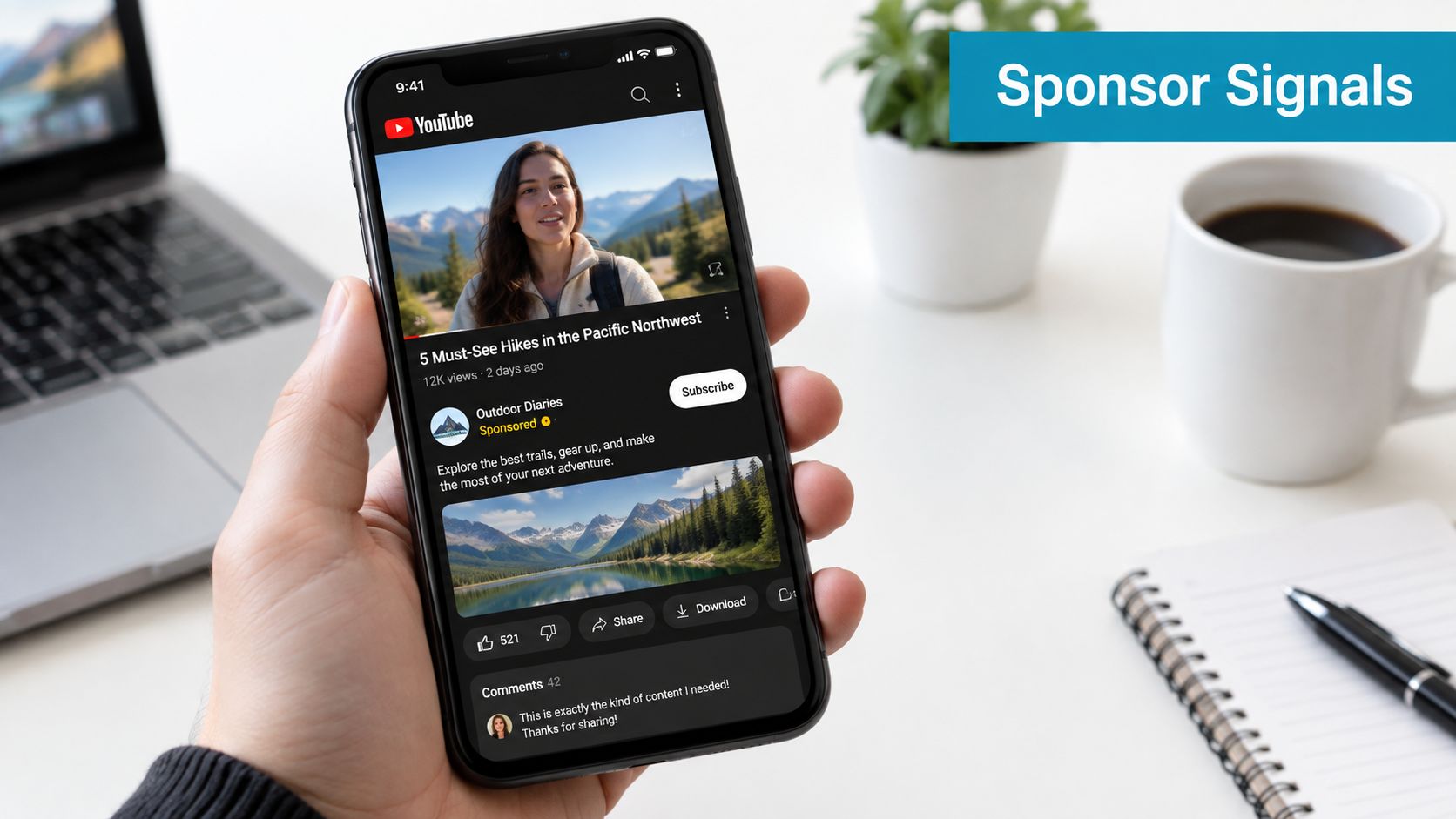
Once a format survives the initial review, inspect the videos for evidence of commercial activity. Don't limit the search to an obvious “sponsored by” disclosure. Integrated sponsorships can appear through an opening mention, a product demonstration, a dedicated segment, a description link, a discount code, or a recurring visual placement.
Build a sponsor signal log
Open several relevant videos and record the commercial details in the same order every time:
- Opening structure: Does the creator establish the audience problem before mentioning the product?
- Placement timing: Does the integration appear before the main payoff, during a natural pause, or at the conclusion?
- Demonstration depth: Does the creator show the product in use, explain a benefit, or read a message?
- Audience action: Is the viewer directed to a link, code, trial, download, purchase, or channel?
- Category repetition: Are several brands from the same sector appearing across comparable videos?
The pattern matters more than a single placement. One sponsorship may reflect a one-off relationship. Repeated appearances across creators suggest that a category has an active acquisition budget or an agency testing inventory.
A sponsor-friendly integration usually respects the video's native promise. A hiking creator can demonstrate a navigation app during route planning. A gaming creator can use a peripheral while solving a visible performance problem. A finance educator can place a tool inside a workflow, provided the claims remain accurate and the disclosure is clear.
Practical observation: The strongest sponsor signal isn't the product mention. It's the product's role in the story.
Don't assume technology and gaming are the only categories worth tracking. Entertainment, regional content, lifestyle routines, education, travel, food, and creator tools can all reveal different buyer behaviors. YouTube's 2025 trend roundup highlighted Squid Game, Labubu, and Roblox's Grow a Garden, while later trend pages showed trailers, gaming content, and local-language videos appearing prominently across major markets (YouTube's 2025 trend roundup, 2026 YouTube trending analysis). The commercial lesson is that fandom velocity and format fit can matter as much as celebrity reach.
Use the following video as a pacing reference before you evaluate integrations in your own niche:
Identify the likely decision-maker
The brand name is only the first clue. A creator partnership may be handled by an influencer marketing manager, affiliate lead, growth marketer, social media manager, public relations agency, or media buying team. Search the company's partnerships page, LinkedIn profiles, campaign announcements, and creator-facing contact details before sending a pitch.
Then classify the opportunity:
- Existing sponsor: The brand has already paid for similar content, so your pitch should explain why your audience adds incremental reach or stronger category relevance.
- Adjacent buyer: The company sponsors a neighboring format but hasn't appeared in your exact niche. Position your concept as a controlled extension.
- Emerging category: Several competitors are testing creator placements. Lead with the audience problem and integration design, not a generic request for collaboration.
That research produces a qualified prospect list instead of a collection of brands you happen to like.
Translating Trend Data Into Sponsor-Ready Formats
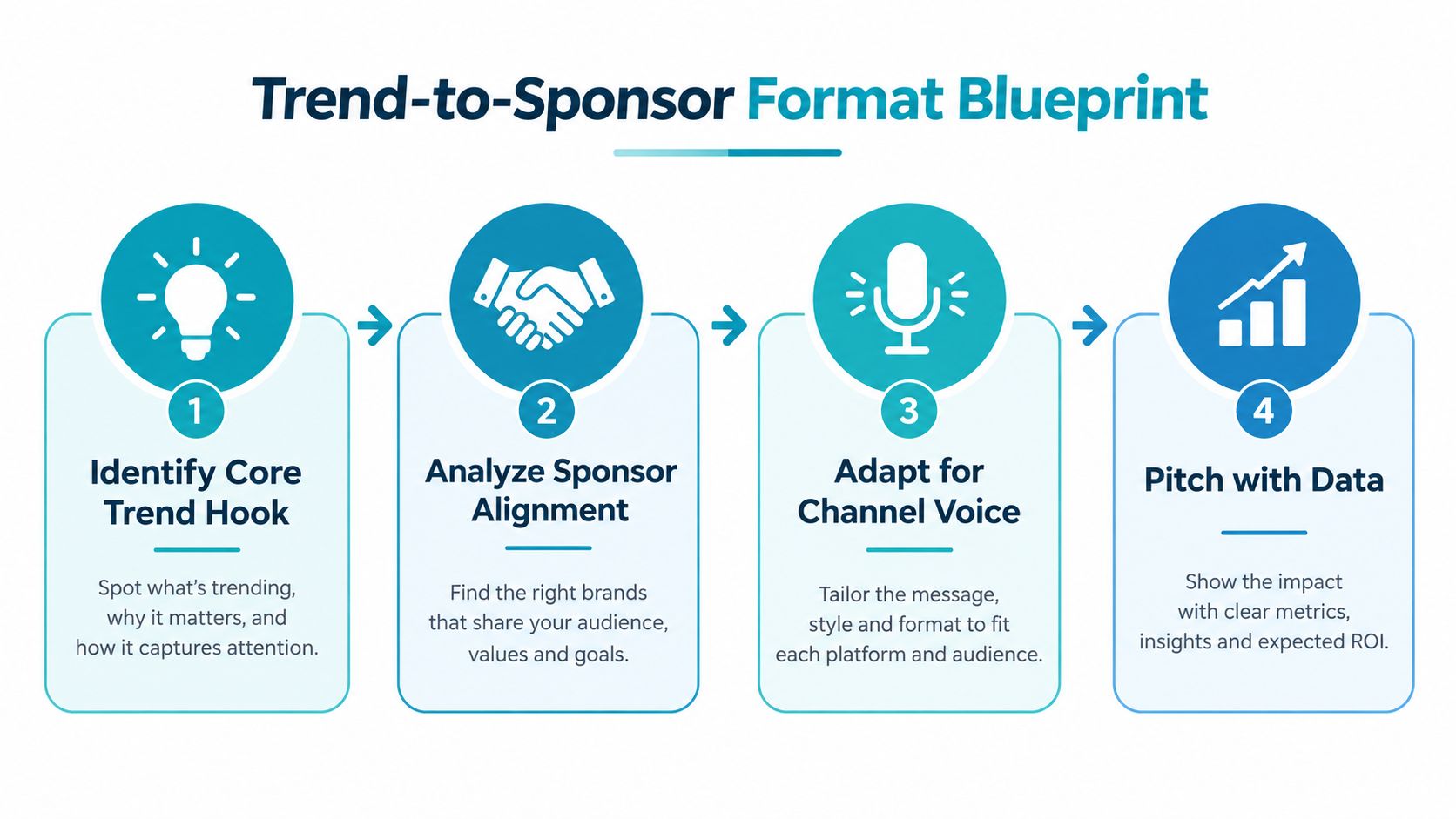
Borrow the structure, not the identity, of a trending video. Copying a title, thumbnail concept, script, or personality can create weak content and legal or reputational problems. Adapt the underlying viewer motivation to your own expertise.
A useful decomposition has four layers:
- The hook: What creates immediate curiosity, urgency, surprise, or participation?
- The proof: What keeps the viewer watching, such as a test, reveal, progression, comparison, or result?
- The setting: What topic or community gives the hook meaning?
- The commercial role: Where can a product solve a real problem without taking over the video?
A gaming trend might use progression and discovery. A cooking trend might use transformation and constraint. A travel trend might use route planning and practical payoff. The same psychological structure can produce entirely different original videos.
Design the integration before the pitch
Creators often wait until a brand says yes before deciding where the product belongs. That creates awkward scripts and makes the proposal difficult for a buyer to evaluate. Build the sponsor slot into the format from the beginning, then leave room for the brand's required claims and approval process.
Consider three integration models:
- Utility integration: The product helps complete the task. This is usually the most credible model for tutorials, reviews, travel, fitness, and productivity.
- Challenge integration: The product becomes a constraint, tool, or variable in the experiment. This can work well when the audience wants to see a result.
- Contextual integration: The creator discusses the product during a natural transition, often with a focused explanation and clear next step.
Avoid forcing a sponsor into a format that depends on uninterrupted emotional momentum. A dramatic reveal may lose energy if the creator stops for an unrelated sales message. A practical comparison may support a deeper product explanation because viewers already expect evaluation.
Make the calendar commercially coherent
Organize your upcoming concepts into three groups:
- Immediate response: A timely adaptation while audience interest is active.
- Repeatable series: A version you can publish again with new subjects, guests, products, or locations.
- Evergreen companion: A search-friendly piece that remains useful after the trend cools.
This mix protects the channel from becoming dependent on one spike. It also gives a sponsor several entry points. A brand may decline a fast reaction video but approve a durable tutorial or a series placement with clearer measurement.
Use SponsorRadar's YouTube media kit template as a prompt for the information a buyer needs to assess the opportunity. Your pitch should connect the trend signal to your audience, your format, the planned integration, deliverables, disclosure, and measurement method.
A sponsor-ready format has two proofs of fit. Viewers have a reason to watch, and the brand has a reason to participate.
Executing Data-Backed Pitches With SponsorRadar
Trend research produces revenue only when it changes your outreach. Move from observation to verification, then turn the verified signal into a proposal built around the buyer's existing behavior.
Start with a short prospect list based on the sponsor signals you recorded. A popular category can contain many irrelevant advertisers. Prioritize brands whose product solves a problem already present in your proposed format.
A practical outreach sequence
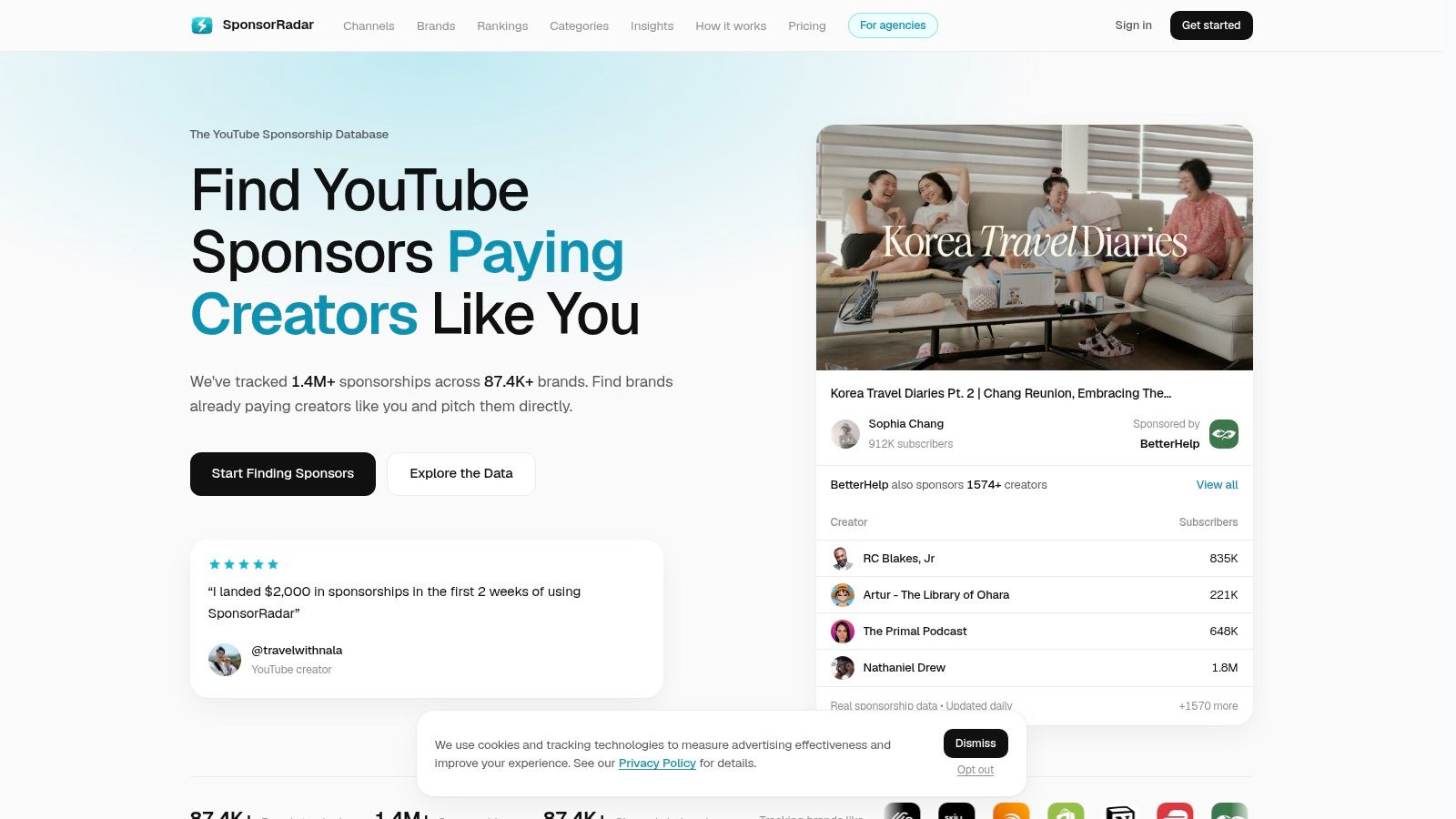
Step 1, verify the buyer. Confirm that the brand has sponsored relevant creators or content. Review recent placements, recurring categories, and campaign language. SponsorRadar is one research option for examining sponsorship activity, related brands, channel overlap, and available decision-maker information.
Step 2, define the commercial hypothesis. Write one sentence explaining why the brand fits your adaptation. “Your product appears in productivity content” is weak. “This workflow video gives your planning tool a visible role while viewers organize the same problem” gives the buyer a usable reason to participate.
Step 3, package the concept. Include the working title, audience, opening hook, integration location, deliverables, publishing window, disclosure approach, and success indicators. Buyers should not have to design the campaign structure themselves.
Step 4, reference evidence carefully. Mention the observed format, geography, or recurring sponsor category without treating a ranking as a performance guarantee. State what you saw and how you will adapt it. Do not promise a specific view count.
Step 5, send a concise follow-up. Add new value, such as a revised integration idea, a related audience angle, or a companion Short. “Just checking in” gives the buyer no reason to reopen the email.
Personalize around the sponsor's existing behavior
A credible pitch shows that you studied the buyer's creator strategy. If the brand appears in gaming videos but not your specific subcategory, explain the bridge. If it sponsors long-form integrations while your concept depends on a Short, position the short-form asset as product introduction and the longer video as the space for education and conversion.
SponsorRadar's publisher description says its database tracks 975K+ sponsorships across 66K+ brands and 65K+ channels, with daily updates. Treat those figures as a description of platform coverage, not evidence that a listed brand will buy from your channel. The practical use is comparative research, identifying brands associated with similar creators and reviewing sponsor overlap across channels.
Your media kit should support the argument, not replace it. Include current audience information, representative content, engagement context, relevant audience geography, proposed deliverables, and a clear contact path. A one-click media kit reduces friction, but the email still needs a specific reason for this partnership.
Avoid three common errors:
- Overclaiming: Trending rank does not guarantee conversions.
- Generic outreach: A broad “we'd love to work together” message appears disconnected from the research.
- Format mismatch: A sponsor cannot evaluate an idea when the integration conflicts with the audience's reason for watching.
Pitch the next logical placement, not your desire to be sponsored.
Tracking Pipeline Metrics and Sponsorship ROI
A trend-based sponsorship strategy needs a measurement system that connects research time to commercial outcomes. Views matter, but they don't tell you whether your prospecting improved, whether the pitch reached the right buyer, or whether the deal justified production effort.
Track the pipeline from first qualified prospect to payment received. Keep trend-originated leads separate from ordinary outreach so you can compare the quality of each source without pretending that one campaign proves a permanent advantage.
Build a simple operating dashboard
Record the date you found the sponsor signal, the trend category, the adapted format, the contact, the outreach angle, the response, the meeting outcome, the proposal status, the contracted fee, production hours, and post-campaign results. Add notes about why a prospect declined. Rejections often expose weak audience fit, unclear deliverables, poor timing, or a mismatch between the format and the buyer's campaign objective.
Useful definitions include:
| Metric | Definition | Target Benchmark |
|---|---|---|
| Qualified prospects | Brands with observed relevance to your format and audience | Set a weekly operating target based on available research time |
| Contact accuracy | Outreach sent to a relevant partnership or marketing decision-maker | Improve until misdirected outreach becomes uncommon |
| Positive reply rate | Qualified prospects that respond with meaningful interest | Establish your baseline, then compare trend-led and general outreach |
| Meeting rate | Qualified prospects that become discovery calls | Track by sponsor category and pitch angle |
| Proposal rate | Meetings that progress to a formal proposal | Review whether the concept and commercial terms are clear |
| Close rate | Proposals that become signed agreements | Compare by format, category, and relationship source |
| Effective production return | Contracted revenue considered against production and research time | Favor formats that produce repeatable profit, not only attention |
| Renewal rate | Paid partners that return for another campaign | Use as a trust and delivery-quality signal |
The table intentionally uses operating benchmarks rather than invented universal targets. Your baseline will depend on niche, audience, offer, pricing, relationship strength, and the quality of your contact data.
Measure the cost of trend research
Log research time like any other production input. If a trend takes hours to analyze but produces no qualified prospects, change the filter. If a small amount of review consistently identifies relevant sponsors and strong concepts, protect that workflow.
Creators who already use social reporting tools can compare the logic with broader LinkedIn analytics tools, especially the distinction between activity metrics and business outcomes. The principle applies across platforms: exposure is not the same as pipeline value.
A lightweight creator CRM can keep contacts, campaign stages, follow-ups, and renewal notes together. SponsorRadar's CRM for creators is one option to evaluate alongside a spreadsheet or another customer relationship tool. Choose the system you'll update after every conversation.
The final test is economic. A trend is worth pursuing when it improves the quality of your content decisions, makes sponsor outreach more specific, and produces profitable partnerships without forcing your channel into a format your audience doesn't trust.
SponsorRadar helps creators research verified sponsorship activity, identify brands connected to similar YouTube channels, organize decision-maker outreach, and present their channel through a professional media kit. Visit SponsorRadar to turn YouTube trending videos into a structured sponsor prospecting workflow, then build your next pitch around a trend signal you can explain and a format you can deliver.